

Kitting is one of the most useful but least understood fulfilment services available to eCommerce retailers. Done well, it boosts sales, saves time, reduces shipping costs and increases average order value. Done poorly, however, and it can add friction to your warehouse operations and leave revenue on the table.
What is kitting?
Kitting is the process of pre-assembling several individual products into a single, ready-to-ship package. Each kit has its own SKU and is treated as a single unit for inventory management, picking, packing and shipping.
Imagine you’re a skincare retailer and you want to sell a product for a specific skin routine. You could take a cleanser, a toner and a moisturiser and kit them into a single branded product.
This is exactly what skincare brand Facetheory does. You can see below that they’ve combined three products available individually into one kit to target consumers seeking clear skin.
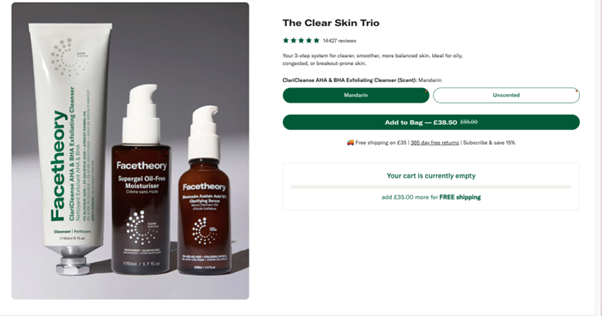
When a customer orders the bundle, the warehouse team picks one product (the pre-assembled package) instead of three. That means the order is fulfilled faster, more accurately and for a lower cost than if it were packed separately.
Kitting vs bundling: What’s the difference?
Kitting and bundling are often used interchangeably, but they’re actually two distinct things.
Kitting is an operational strategy that creates a new unit with its own SKU. Bundling is a sales and marketing tactic that combines several products into a single discounted price.
You can bundle together any of the products you sell. But most retailers only create kits from products that are related, frequently bought together or naturally form part of the same use case. Kitting random, unrelated products rarely adds value for the customer or the warehouse.
How does the kitting process work?
The kitting process varies depending on volume, complexity and whether it's handled in-house or by a 3PL. But the core steps are consistent across most operations:
- Identify products to kit. Analyse order history to find the product combinations customers buy together most frequently. These are your highest-priority kitting candidates.
- Create an SKU. Assign each kit a unique SKU in your inventory management system. This allows the kit to be tracked, picked and shipped as a single unit.
- Stage components at a kitting station. Pull components from their regular storage locations and bring them together at a dedicated kitting workstation.
- Assemble the kit. Assemble the components according to a defined kit specification. Create a checklist or assembly guide to ensure consistency across every unit, regardless of which team member builds it.
- Quality check. Inspect completed kits against the specification before sealing and labelling.
- Label and store. Label the kit with its unique SKU and move it to a dedicated storage zone, ready to be picked as a single unit when an order arrives.
- Fulfil as a single order line. When a customer orders the kit, you can pick, pack and ship exactly like any other individual product.
Examples of kitting in eCommerce
Almost any retailer can use kitting, regardless of its eCommerce business model. Here are the most common applications:
Subscription boxes. This is probably the most prominent use of kitting in eCommerce. Subscription boxes, whether they’re sold by beauty brands, pet retailers or meal subscription services, are a curated collection of products in a single box. The entire business model depends on efficient and accurate kitting.
Seasonal and promotional gift sets. Christmas gift sets and Mother’s Day hampers are classic examples of kitting. All of these products are available individually all year round, but retailers pre-assemble them into popular, gift-ready packages for defined windows. Because of the perceived added value of a curated set, retailers can often price kits above the combined cost of the individual items.
Product and accessory kits. A common upsell when you buy a high-value item like a smartphone or laptop is to offer product or accessory kits. A case, a charging cable and a screen protector with a smartphone purchase, for instance. It’s a great way to increase average order value and reduce the number of separate warehouse picks per order.
Starter and trial kits. Brands that want to introduce customers to a product range often use kitting to create accessible entry points, such as a selection of trial-sized products assembled into a single package.
What are the benefits of kitting?
Kitting delivers advantages that extend well beyond the warehouse, from faster fulfilment and lower costs to a better experience for your customers.
Faster order fulfilment
When you pre-assemble common product combinations, you significantly reduce the time and effort it takes to pick them in the warehouse. The cumulative time saving across hundreds or thousands of orders per day can be significant.
Fewer picking errors
Picking errors happen when warehouse staff are under time pressure and assembling complex multi-item orders on the fly. Kitting removes that complexity at the point of fulfilment, allowing pickers to grab one pre-verified kit rather than five individual items.
Lower shipping costs
If you ship three products in three separate boxes, your carrier will charge you three shipping costs. But when you kit those products into a single box, you only pay one shipping charge. You also use less packaging material.
Higher average order value
Kits encourage customers to purchase more products. A customer who comes to buy a moisturiser is more likely to buy a cleanser and toner if the kit is already put together, presented attractively and priced appropriately.
When does kitting make sense?
Kitting is suitable for a wide range of retailers. If you’re still not sure, here are some scenarios where it makes sense:
- You sell the same product combinations repeatedly and predictably
- You have a subscription or recurring order model
- You operate in seasonal categories with defined gift-giving peaks
- Your products are frequently bought together, but not always sold as a set
- You're looking to increase average order value through curated bundles
- You want to reduce pick time and error rates on high-volume, multi-item orders
Kitting makes less sense for low-volume, one-off combinations and businesses that sell highly customised orders or have inventory that’s too small to justify pre-assembly.
Ship your kits seamlessly with Pro Carrier
Kitting is only half the equation. After you assemble your kits, they still need to reach customers quickly, reliably and in perfect condition. And when they don’t, returns need to be just as smooth.
Pro Carrier’s cross-border eCommerce delivery solution is built for this. Our carrier-agnostic approach gives you access to the best final-mile carriers in each market through a single integration and tracking solution.
Our returns service is just as seamless. We inspect every item that comes back, prepare it for resale and hold quality-checked stock at our facilities ready for reshipment. Speak to an expert today to find out how Pro Carrier can support your kitting strategy.