
Table of contents
Selling internationally is one of the best growth opportunities open to UK retailers. But entering a new market is about more than finding an international delivery service and converting your pricing. If you don’t tailor your entire eCommerce experience to your new market, you’ll struggle to convert visitors — no matter how great your product is.
That’s what eCommerce localisation does. It’s the process of adapting your store so that it feels native to every market you sell in. Done properly, it covers everything from the language and currency on your product pages to the UX and payment methods at checkout, the marketing channels you use and the delivery messages you send customers.
Why eCommerce localisation matters for cross-border brands
eCommerce localisation means adapting every facet of your site for a specific market. Unlike translation, which simply converts your website copy from one language to another, it considers the entire customer journey.
It also takes into account the nuances, idioms, cultural norms and consumer expectations of each target market to significantly increase conversion rates.
The case for eCommerce localisation is compelling. Research by Common Sense Advisory finds that:
- 72.1% of consumers spend most or all of their time on sites in their own language
- 72.4% of consumers are more likely to buy products with descriptions in their own language
- 56.2% of consumers believe obtaining information in their own language is more important than price
For UK retailers operating in foreign markets, an English website is a barrier to conversion. With that in mind, here are five best practices to localise your international sites.
1. Create a multilingual content strategy
A common mistake when localising eCommerce content is translating everything word-for-word and calling it done. Instead, create a multilingual content strategy that accounts for the role of each page and prioritises them accordingly.
Make product pages, check out and post-purchase communications a priority. These touchpoints have the greatest impact on conversion and customer satisfaction. You can localise supporting content — such as blog posts or FAQs — once the core experience is in place.
AI translation tools can help you quickly localise copy, but you may wish to work with native speakers or professional translators to account for local cultures and preferences.
When translating marketing copy, for example, you’ll want to recreate the message from scratch for a new market rather than translating your English copy word for word. This will preserve the intent and emotion — and should result in higher conversion rates.
2. Change your URL structure and technical SEO
Make sure to update the technical aspects of your site during ecommerce localisation. If you want to rank on Google in a foreign market, your URL structure needs to tell search engines clearly which content is intended for which audience.
There are three common approaches:
- Country code top-level domains (ccTLDs) — e.g. yourstore.de for Germany. This sends the strongest signal to Google and builds local trust, but it's the most expensive and complex to manage.
- Subdomains — e.g. de.yourstore.com. A middle-ground option that separates content without requiring separate domains.
- Subdirectories — e.g. yourstore.com/de/. The easiest to implement and maintain, and preferred by many SEO professionals because it consolidates your domain authority.
As you can see in the image below, ASOS prefers the third option:

Whichever structure you choose, make sure you implement hreflang tags correctly. These tell search engines which version of a page to show to users in each country or language. Without them, you risk cannibalising your own rankings or serving the wrong content to the wrong audience.
3. Localise the user experience
Ecommerce localisation is about creating a seamless experience for cross-border customers. Small UX details that seem minor can create significant friction if they're not adapted for local expectations.
Take date and time formats, for example. The date 2/3/2026 means 2nd March to UK consumers but February 3rd to US shoppers. It’s the same for phone number formats, weights, and decimal points.
Don’t forget the payment experience, either. Few retailers will forget to display prices in a customer’s local currency, but you should also localise prices and payment methods.
Local competition, purchasing power and price sensitivity all vary. Research competitor pricing in each market and assess whether your current positioning makes sense locally.
Do the same for payment methods. In the Netherlands, for example, iDEAL is the dominant payment method. In Scandinavia, Klarna and buy now, pay later options dominate. In Asia, you’ll need to think about digital wallets and other mobile payment methods. It might seem like a headache setting up accounts with dozens of financial firms, but it can pay dividends in the long run.
4. Offer local language customer service
If a customer in France or Spain has a question about their order, they’ll expect to receive help in their own language. Offering customer service only in English will deter purchases and damage your reputation in foreign markets.
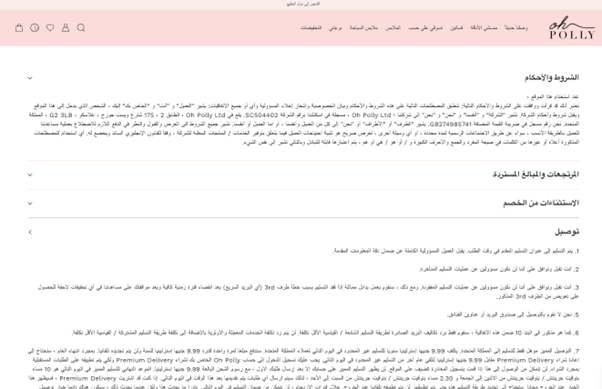
You don't need to staff a dedicated team for every language from day one, however. Start by translating FAQs and using a chatbot with multilingual capabilities to handle common enquiries. This is exactly what fashion brand Oh Polly does to better serve customers in the Middle East:
As your volume in each market grows, investing in native-speaking customer service agents becomes increasingly worthwhile.
5. Localise the delivery experience
Delivery is one of the most overlooked areas of ecommerce localisation — and one of the most impactful.
It starts with transparency about duties, taxes, and delivery fees. You’ll want to display the total landed cost of products before the customer reaches the payment screen to reduce cart abandonment.
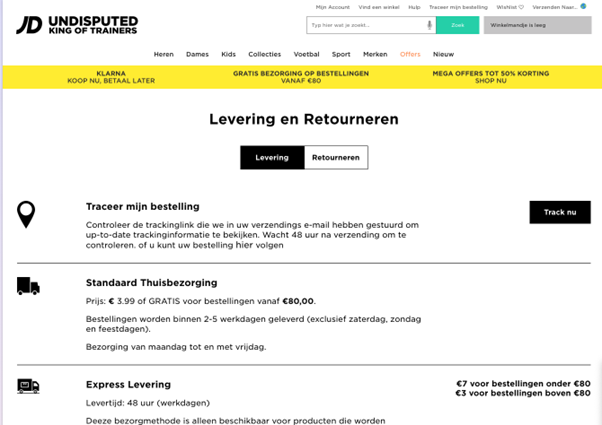
Provide delivery and return information in local languages, too, so customers know their rights before making a purchase. JD does this for every market, as you can see below:
Next, work with one or more international couriers to deliver fast and cost-efficient delivery to your cross-border markets. Keep customers informed with localised post-purchase notifications, too.
Tracking updates, delivery notifications, out-for-delivery alerts: these should all be delivered in the customer’s local language.
This is where Pro Carrier's cross-border shipping service adds genuine value. We don’t just offer a global network of final-mile delivery partners; we also deliver localised updates to your customers in their own language, keeping them informed and reassured throughout the journey. Rather than leaving customers to decipher English-language tracking pages, we ensure every communication feels native, no matter where the parcel is headed.
Go global with Pro Carrier
Ecommerce localisation is all about making international customers feel as valued as your domestic ones. From your URL structure and pricing to your product content and customer service, every touchpoint must reflect your target market's expectations.
But your website is only one half of the equation. The delivery experience customers receive — especially post-purchase — is vital to building trust and loyalty in foreign markets. That's why localisation needs to extend all the way to the final mile.
Pro Carrier's carrier-agnostic cross-border shipping service is built for UK retailers who want to sell internationally without compromise. With a global network of final-mile delivery partners, seamless integrations with all major ecommerce platforms and localised delivery notifications, we take the complexity out of cross-border commerce.
To find out more about how we can support your cross-border growth, speak to an expert today.